

I was driving down Governors Highway, a four-lane street I often take to my office, when I heard a loud thump on my right front tire. We’ve had tornadoes lately, and a lot of heavy branches were littering the road. The noise subsided as I reached the next light.
As I stopped, I heard honking on the right side of the car. A young Black man was gesturing for me to open my window. He told me I had a big tree branch under my tire. I thanked him. Then he got out of his car, pulled the branch out and tossed it onto the grass. I was a bit stunned. He had done something really nice, totally unsolicited, and then he just drove off. I doubt I would have done the same for him.
***
In my lifetime, race relations have changed a great deal. My parents fled our home on the South Side of Chicago because “schvartze” (Yiddish for Black people, with a negative connotation) were living too close. Today we live in a neighborhood where our Black neighbors watch our home when we are gone and have our keys.
America has changed. We have changed.
Last week, Coco Gauff played in the women’s semifinal of the U.S. Open at Arthur Ashe Stadium. On Friday, two African American men played each other in a Grand Slam semifinal for the first time ever, also in Arthur Ashe Stadium, named after the great African American player who died at 49 in 1993. [UPDATE MONDAY, semifinal winner] became the first African American man to play in a Grand Slam final since MaliVai Washington at Wimbledon in 1996. [UPDATE MONDAY, one sentence on Sunday’s final vs. Zverev or Khachanov]
Ashe is a hero of mine, not just because I have loved tennis since I played with my Dad at Rainbow Beach in Chicago as a kid and Ashe was an exquisite player, but also because he had such a sad and awful health history. He had a heart attack at 36 and quadruple bypass surgery that same year. In 1983 he needed a second bypass and received a blood transfusion that had not been tested for HIV. He ended up with AIDS and died from complications of the disease ten years later.
This U.S. Open also marks the 18th anniversary of my own quadruple bypass surgery.
***
This year’s men’s semifinal between two African American men comes with some wonderful American stories.
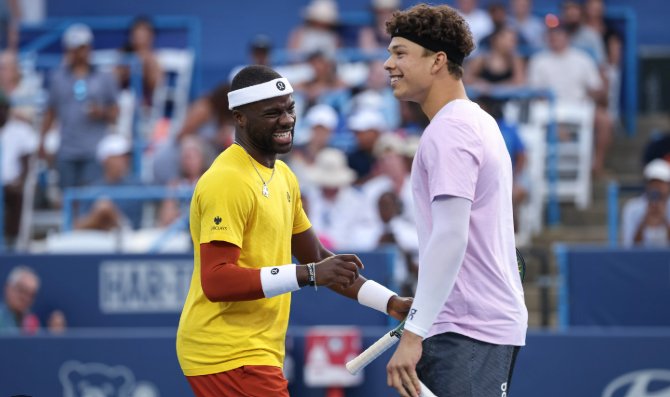
Frances Tiafoe vs. Ben Shelton.
Tiafoe’s parents came to the United States in the 1990s, fleeing the civil war in Sierra Leone, a small country on the Atlantic coast of West Africa. His father took whatever construction jobs he could get. His mother became a night nurse. His father helped build the Junior Tennis Champions Center in College Park, Maryland, and stayed on as its custodian. Frances and his twin brother basically grew up at the center and watched some of the best young players in the country hitting. He started copying them at about five.
His father turned a storage room at the center into a place to live. When their mother worked nights, Frances and his brother slept there too, on a massage table.
As Tiafoe got older and showed some promise as a player, he was allowed to practice with the established juniors. Eventually he joined them and got free coaching. Tournaments followed. Tiafoe turned pro in 2015 at 17. Eleven years later, he [UPDATE MONDAY, has/had] his big chance at the pinnacle of pro tennis.
Ben Shelton has his own unusual story. His dad, Bryan, grew up in a military family in Huntsville, Alabama. He saw kids playing on public courts and thought it looked like fun. He practiced locally, won the state high school championship twice, got a tennis scholarship to Georgia Tech, became an All-American and earned an industrial engineering degree.
He turned pro and made it to No. 55 in the world. Then he returned to Georgia Tech and coached the women’s team to the 2007 NCAA Championship, the first national title in any sport in school history. He later coached the University of Florida men’s team to a national championship in 2021.
His son, Ben, was on that team and won the NCAA singles title in 2022, but his father did not push him onto the junior tennis circuit. Ben preferred football growing up and was not chasing Wimbledon at eight years old. But when Ben showed he really wanted to go for the prize, his dad became his coach and constant companion on the tour.
Both Frances and Ben are big, strong guys. Both wear clothes that show off their bodies. Shelton hit serves up to 150 mph in his quarterfinal against defending champion Carlos Alcaraz. Both won their quarterfinals in grueling five-set matches.
***
Tennis and race relations have come a long way in my lifetime. Althea Gibson, then Arthur Ashe, the Williams sisters, and now [UPDATE MONDAY, semifinal winner] in the men’s final.
Friday was September 11th, 25 years after the attacks. A day of pain, but so much to celebrate.
Questions: How has your neighborhood changed since you were a kid? Who was your sports hero growing up?
