

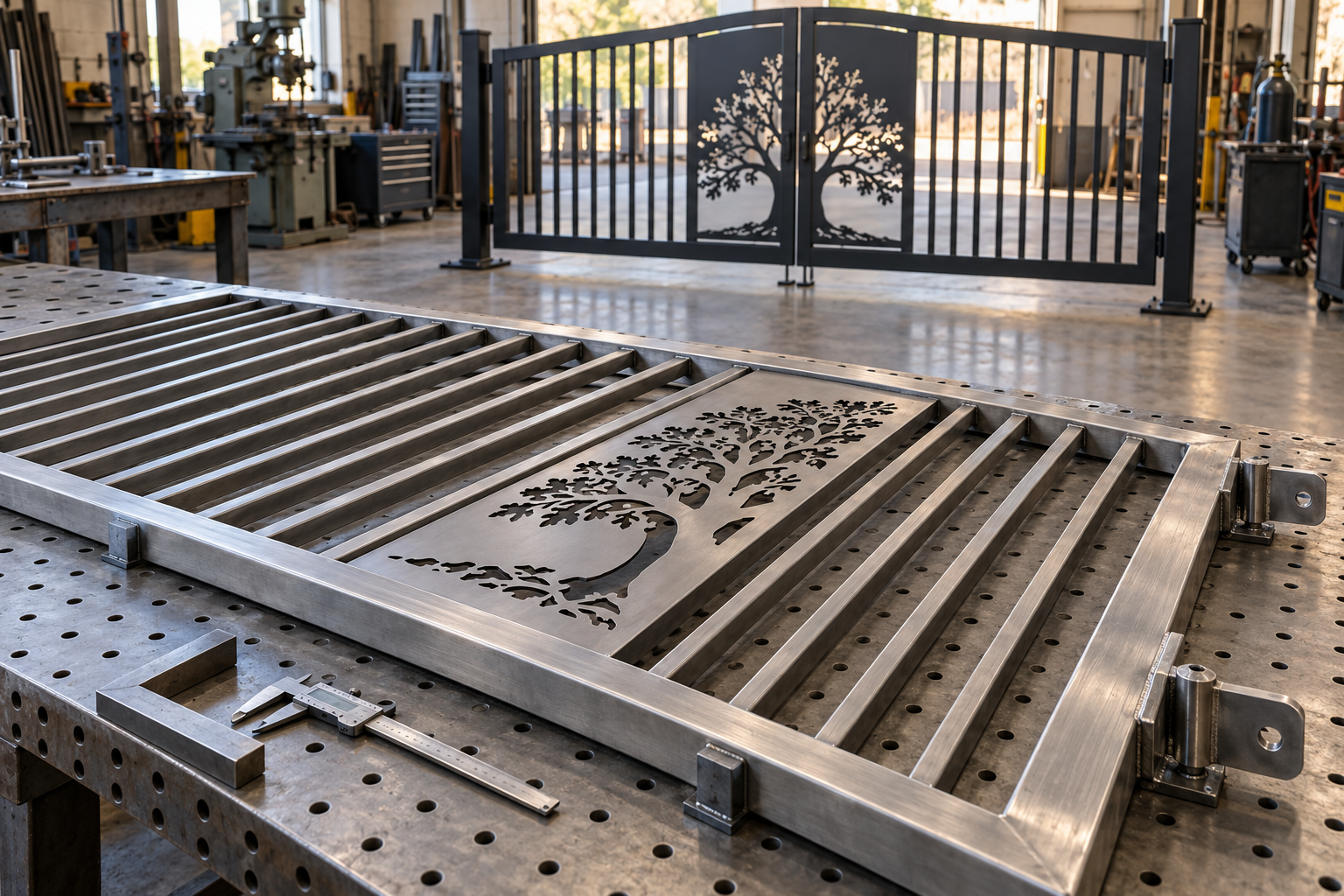
In engineering terms a custom driveway gate is quite a different thing from the ornamental piece it appears to be, since it is really a large weldment that has to stay square outdoors for decades while a motor swings it open and shut thousands of times a year. For anyone who has spent time on a shop floor the ways in which it fails are easy to recognize: tolerances stacking up across a long frame, distortion brought on by welding heat, poor fit-up and edges that were never properly prepared for coating. A sagging leaf, a latch that binds or a line of rust along a decorative panel can usually be traced back to one of these, and as a result the shops treating gates as precision work tend to see far fewer of them come back.
Accuracy Starts at the Cut
Most of the decorative content in a modern gate is cut from plate or sheet on a CNC table, and the choice of process has an effect on a great deal more than appearance. On gates, the practical differences between plasma and laser cutting tend to show up at the edges, where the coating either holds or starts to lift after a few seasons. With a laser the kerf is narrow and the heat-affected zone small, which makes it very good at fine detail such as small lettering; the edge it leaves, however, is square and sharp, and that is exactly where paint and powder coat pull back during curing. Plasma in contrast cuts a wider kerf with a larger heat-affected zone, so intricate sections can warp in the event that the torch dwells too long, although the edge it leaves is a bit softer. In the case of large, bold patterns a lot of the laser’s finer detail is lost at normal viewing distance, whereas its sharper edge still has to be dealt with before coating. Both processes can leave an oxide layer on the cut face, particularly when oxygen is used as the assist gas, and that layer has to be removed before any primer will bond properly.
For thick plate, or parts where heat is a concern, abrasive waterjet cutting avoids the heat-affected zone altogether at the cost of slower cycle times. It is quite common for it to be kept for brackets, hinge plates and other parts having tight flatness requirements, since speed matters a good deal less on those than on the decorative panels.
Tight Openings Are a Compliance Issue Too
On automated gates precision matters for safety reasons as well. Under ASTM F2200, the construction standard for automated vehicular gates, openings in a horizontal slide gate are to be guarded or screened from the bottom of the gate up to 72 inches so that a 2 1/4-inch sphere cannot pass through them. On a slide gate that may be twenty feet long, small errors in picket spacing or pattern geometry add up quickly, and a cumulative drift of a quarter inch is all that is needed to turn a compliant opening into a non-compliant one, particularly when the spacing is laid out by hand. It is worthwhile checking a first article with a simple go/no-go ball gauge before the rest of the run is welded up, in much the same way that a machinist would verify a bore.
Fit-Up Decides Weld Quality
When cut and formed parts fit together without gaps the welds can be kept smaller, and in this way less heat goes into the frame and less distortion comes out of it. A rigid fixture holding the frame square, as well as a balanced tack and weld sequence, generally does more for a straight gate than any amount of straightening afterward. Good fit-up also reduces how much the finished gate depends on one welder’s skill at bridging gaps, and this matters more with every passing year. The Bureau of Labor Statistics still projects about 45,600 openings for welders, cutters, solderers and brazers each year through 2034, even though overall employment in the trade is expected to grow only about 2 percent, so a great deal of that work is likely to fall to people who are still building experience.
Edge Preparation Is Where Durability Is Won
At sharp edges coatings behave in quite a predictable way, thinning out and pulling away as they cure, and corrosion therefore tends to start there considerably earlier than on a flat surface. For this reason protective coating specifications commonly call for edges to be rounded, a radius of around 2 mm being a typical target. Abrasive blasting is able to soften cut edges and strip mill scale and oxide in the same pass, after which a zinc-rich primer and a durable topcoat give the steel a real chance outdoors. Holes should be deburred as well, since a burr standing proud of the surface will poke through the film. Small drain holes are usually drilled at the low points of tube frames, because water trapped inside a closed section will sooner or later find its way out through the weakest weld.
Geometry That Holds Over Time
Wall thickness and bracing need to suit the weight of the leaf, its length and the wind it will see, since a gate that is flexed by every push of the operator loads its hinges unevenly and before long starts to sag. Hinge alignment, on the other hand, deserves the same attention as a machined bore, because a small angular error at the post is magnified into quite a large one at the latch end. Many shops make a habit of measuring both diagonals before the frame comes off the fixture and holding them within a tight tolerance, this being a quick way of catching a frame that has been pulled out of square during welding.
Generally, the most practical way of bringing all of this together is to treat a gate like any other job: the first piece is inspected for diagonals, opening sizes, edge condition and coating thickness, and the results are recorded and kept with the job file. A gate built in that way will still swing true and close cleanly years after it has left the shop.
Author Bio: Justin Rose is a gate designer, custom metal fabricator, and the founder of JDR Metal Art; building high-end custom driveway gates and automated entry systems for over 500 homes, farms and ranches across the US since 2011. He combines a deep understanding of advanced automation technologies, precision welding, and custom powder coating finishes to create durable, heirloom-quality entrance solutions for estates, ranches, and residential properties across the United States.
