
The push for lights out manufacturing has never been stronger, but for many machine shops, the path to get there is blocked by a massive hurdle: implementation. Traditional CNC automation solutions—specifically robotic arms and cobots—come with steep learning curves, massive price tags, and weeks of disruptive on-site integration.
But a new approach to automated machine loading is changing the math for job shops and production facilities alike. Gimbel Automation has introduced a “Semi-Turnkey” model for CNC machine tending that delivers the guaranteed results of a full turnkey system, but at a fraction of the cost and without the need for on-site engineers.
The Problem with Robot Loading for CNC Machines
When shops look to implement a machine tending robot, they quickly discover that buying the hardware is only the first step. The real cost of CNC robotics integration lies in the engineering.
Programming a robot to communicate with a CNC machine, designing the end-of-arm tooling, building the custom workholding, and proving out the process can take weeks. Even with “easy-to-use” cobots, shops without dedicated applications engineers often struggle to get the system running reliably.
If a shop opts for a full-service turnkey integration, they are paying a massive premium for engineers to travel to their facility, stay in hotels, and spend days on the shop floor proving out the process. This makes the ROI equation difficult to justify for anything but the highest-volume jobs.
How the Semi-Turnkey Model Works
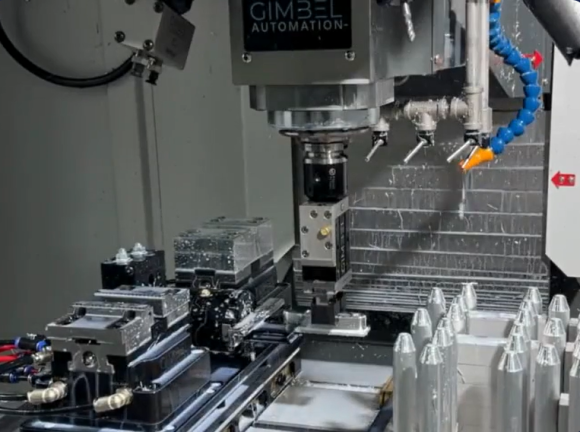
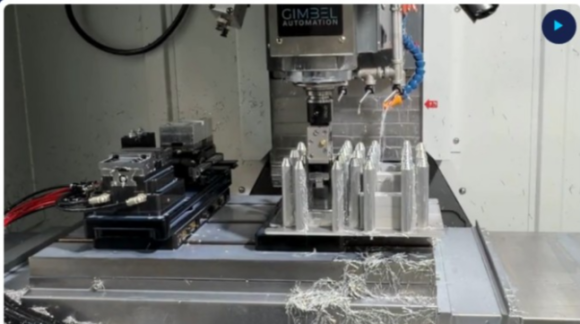
Gimbel Automation’s Semi-Turnkey approach flips this model on its head by leveraging in-machine automation. Instead of using external robots, Gimbel’s systems use the CNC machine’s existing kinematics—the spindle and the automatic tool changer (ATC)—to load and unload parts. This eliminates the need for floor space, safety fencing, and complex robot programming.
| 1 | Process Design | The shop provides their part models and machine details. Gimbel’s engineers design the complete CNC workholding and automation process. |
| 2 | In-House Validation | Instead of traveling to the customer’s shop, Gimbel builds, tests, and fully validates the entire automation process on one of their own test-bed CNC machines. |
| 3 | Delivery & Web Training | The fully proven system—including the spindle gripper, custom pneumatic vise jaws, macro programs, and templates—is shipped to the customer. |
| 4 | Rapid Installation | Because the system was already proven out, the customer simply bolts the components to their table. “If you can tram in a vise, you can easily install the Semi-Turnkey components.” |
The GripFlipGrip™ Two-Op Workflow
One of the most powerful applications of this Semi-Turnkey model is Gimbel’s GripFlipGrip™ module, which enables complete two-op automation in a single cycle. The entire workflow is handled by the machine’s spindle—no external robot required:
- The operator loads raw stock into a high-density part loading tray. No clamping required—pins instantly align each piece.
- The spindle-mounted gripper automatically grabs the raw stock and loads it into the Op1 self-centering pneumatic vise.
- After Op1 is machined, the gripper moves the part to the QuickFlip180™ pneumatic part flipper, which automatically inverts the component.
- The gripper regrabs the flipped part and loads it into the Op2 vise for final machining.
- The process repeats unattended until the entire tray of finished, ready-to-use parts is complete.
Semi-Turnkey vs. Robotic Machine Tending
| Factor | Gimbel Semi-Turnkey | Robotic Cell / Cobot |
| Typical Cost | 8–14% of robotic cell | $75K–$250K+ |
| Floor Space | Zero (inside machine) | Requires fencing / footprint |
| Programming | Auto-generated templates | Manual / teach pendant |
| Implementation Time | Days (bolt-on install) | Weeks to months |
| On-Site Engineers | Not required | Typically required |
| Two-Op Capability | Built-in (GripFlipGrip) | Requires additional tooling |
| ROI Guarantee | Yes — 1-Year Guarantee | Rarely offered |
| Machine Compatibility | Haas, Brother, Fanuc, DN, DMG Mori, Mazak, Okuma, & more | Varies by integrator |
Why Shops Are Making the Switch
Drastically Lower Cost: By eliminating on-site engineering and using in-machine components rather than external robotics, Semi-Turnkey systems typically cost a fraction of a traditional robotic cell.
Guaranteed Results: Every Semi-Turnkey is fully validated on Gimbel’s test-bed machines before shipping. It comes with a Turnkey Success Guarantee—if the part cannot be automated, the shop gets their money back.
Zero Floor Space: Unlike a pallet changing system or robotic cell that requires safety fencing, in-machine automation lives entirely inside the CNC enclosure. No lost shop floor real estate.
Immediate ROI: With CNC automation starting at a fraction of the cost of traditional solutions, shops are seeing a return on investment in months, not years. Gimbel backs it with a One-Year ROI Guarantee.
For machine shops looking to increase spindle uptime and step into unattended CNC machining without the headache of complex robotic integration, the Semi-Turnkey model offers a proven, fast-track path to lights out manufacturing.
The system is compatible with virtually any vertical milling center, including Haas, Brother, Fanuc, DN Solutions, DMG Mori, Mazak, Smart, Syil, Okuma, and Matsuura.
To learn more about CNC turnkey solutions and in-machine automation, visit GimbelAutomation.com or explore Semi-Turnkeys here.