

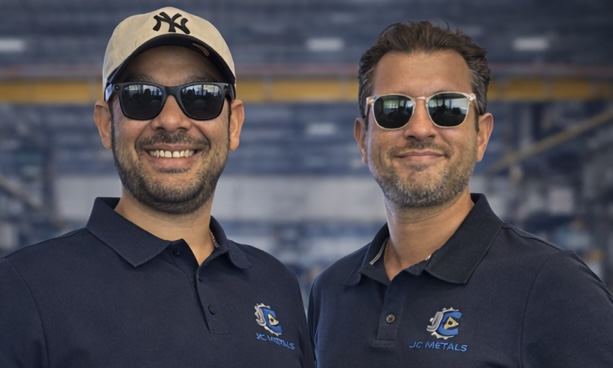
While his nine-year-old son was fighting stage three cancer, Nick Stevens was driving around buying up scrap tungsten carbide just to keep food on the table. It worked well enough that one day, sitting in the hospital room, his son said to him: “Dad, why don’t you just start your own business and be your own boss?”
Today Nick and his cousin Joey run JC Metals, going around the country paying cash on the spot for the carbide piling up in shops. And they refuse to sell a pound of it overseas even when buyers offer them more money to do it.
Listen on your favorite podcast app using pod.link.

 .
.
View the podcast at the bottom of this post or on our YouTube Channel.
Facebook: https://www.facebook.com/swarfcast
Instagram: https://www.instagram.com/swarfcast/
LinkedIn: https://www.linkedin.com/company/todays-machining-world
X: https://twitter.com/tmwswarfblog
*************
Link to Graff-Pinkert’s Acquisitions and Sales promotion!
Main Points
While You Wait, the Price Moves
Carbide tooling has gotten expensive. Between the tariffs and China restricting exports, prices have been swinging all over the place. Every machine shop has scrap carbide sitting around, worn inserts and chipped end mills that are useless for precision work but still worth real money as raw material. A lot of shops don’t realize how much. Nick says he walks into places with piles of carbide they’re practically throwing away, not knowing it’s worth $40,000 or $50,000.
JC Metals buys it and sells it to a private US processor, one that recently received what Nick describes as an $11 million government grant to buy up as much domestic carbide as possible and keep it in American manufacturing. The major toolmakers all have their own buyback programs too. Kennametal, Sandvik, Seco. They work, but the model is the same: ship your material out and wait on a check for 15 to 30 days. With prices moving the way they are, the number you agreed to when you shipped is not the same number when the check clears.
JC Metals shows up with their own scales, weighs everything in front of you, and pays you that day. Cash, wire, Zelle, ACH, whatever you want.
The Geopolitics of Scrap
China controls about 85 percent of the world’s tungsten carbide supply and has been cutting off exports. Foreign buyers have been approaching American shops directly, offering 30 to 40 percent more per pound to ship the material back overseas. Nick says he outbid one of those buyers last month, knowing he would lose money doing it, because he didn’t want the material leaving the country.
Tungsten carbide is a core component of armor-piercing ammunition, from rifle rounds to tank rounds. It’s also used in nuclear weapons casing. Until this interview I knew tungsten carbide was a big deal for manufacturers. I had no idea about the national security ramifications.
Changing the Scrapper Stigma
My great grandfather was in the scrap metal business. One reason my grandfather went into used machinery instead was that he found the scrap business unsavory, manipulating scales, shady deals. When we had a warehouse it wasn’t uncommon for scrappers to pull up in a truck and steal from Graff-Pinkert.
Nick and Joey bring their own scales so there’s no question about the weight. The company name, JC Metals, stands for Jesus Christ Metals, a nod to the faith that carried them through Jack’s illness.
Jack Stevens, Nick’s son, is ten months cancer free.
Question: What do you do with your scrap carbide?
Podcast: Play in new window | Download

2 Comments
I have not sold any since I started my shop in 2007, I have quite a pile of endmills and inserts. I wanted to seek out someone years ago but had a bad experience with another scrap buyer when I worked for another shop, so I just left it pile up.
Hi Andy, this is Nick with JC metals. I’m sorry you had a negative experience in the past but we would like to make it a positive experience. Please feel free to call or text me at 973-710-5414 or you can contact us directly through the website http://www.jcmetals.net.