

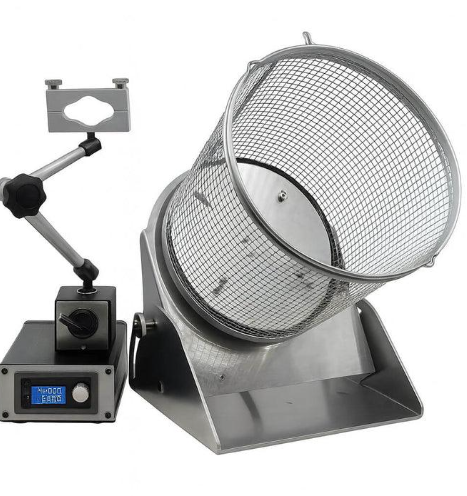
Powder bed fusion technologies like Selective Laser Sintering (SLS) and Multi Jet Fusion (MJF) have revolutionized manufacturing by allowing complex, support-free geometries to be printed at scale. But anyone running a print farm knows the dirty secret of powder bed 3D printing: the printing is the easy part. The real bottleneck is SLS post processing.
When a build finishes, the parts are encased in a dense “cake” of unsintered nylon powder. After the initial breakout, operators must spend hours standing at a manual blast cabinet, individually blasting each part to remove the stubborn powder clinging to the surface and internal cavities. This manual SLS depowdering is tedious, dusty, and incredibly labor-intensive.
The Cost of Automated Depowdering
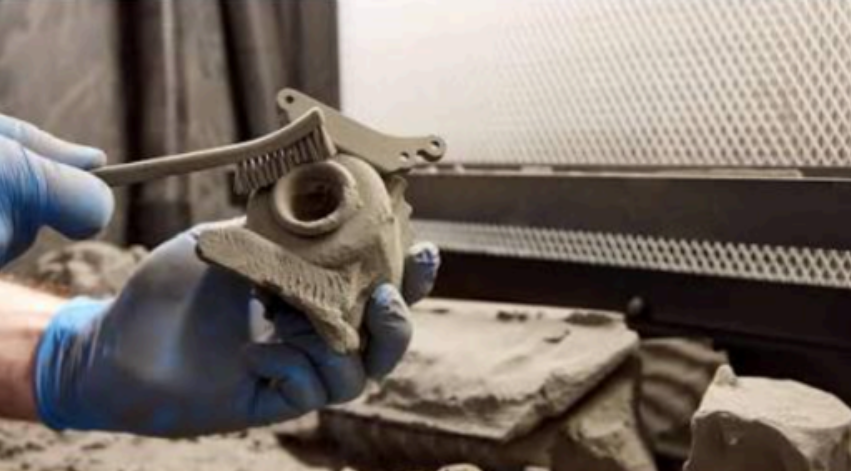
As print volumes scale, manual blasting quickly becomes unsustainable. The traditional upgrade path is to purchase a dedicated automated powder removal 3D printing system from companies like DyeMansion or AMT.
These industrial systems are fantastic — they use rotating baskets and ionized air or media to clean parts automatically. However, they also carry industrial price tags, often starting at $15,000 and easily exceeding $30,000. For small-to-medium print farms, job shops, or engineering labs, that capital expenditure is simply out of reach, leaving them stuck with manual labor.
The Drop-In Alternative: TumbleBlast™
There is a massive gap in the market between a 30,000 automated finishing system. Gimbel Automation — a company that manufactures thousands of SLS printed gripper fingers for their CNC automation products — encountered this exact problem. Their solution was to invent the TumbleBlast™.
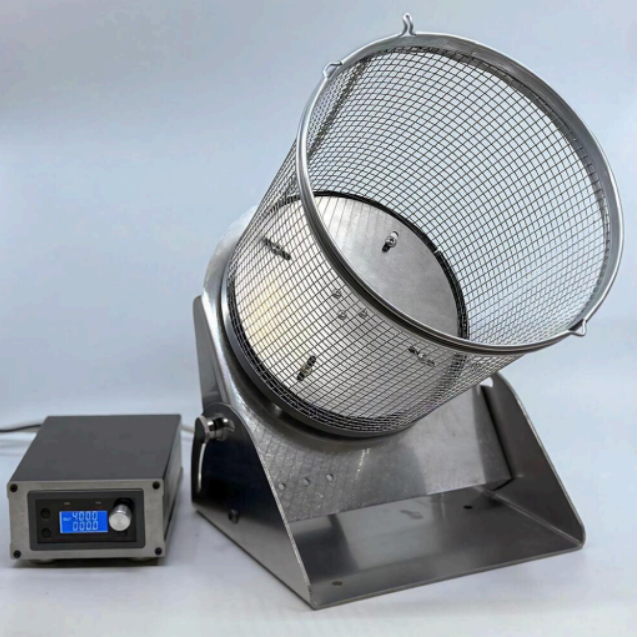
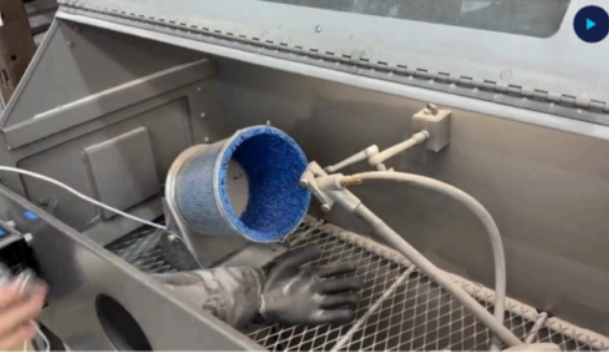
The TumbleBlast is a drop-in automatic tumble basket designed to sit inside any standard manual blast cabinet. Priced at just $879, it effectively turns a cheap manual cabinet into an automated media blasting 3D prints station.
How It Works for 3D Printed Parts
The workflow is remarkably simple. Instead of holding parts one by one, the operator loads a batch of raw SLS or MJF parts into the stainless steel mesh basket. They then use the included articulating blaster mount to aim the cabinet’s existing blast gun directly into the basket opening.
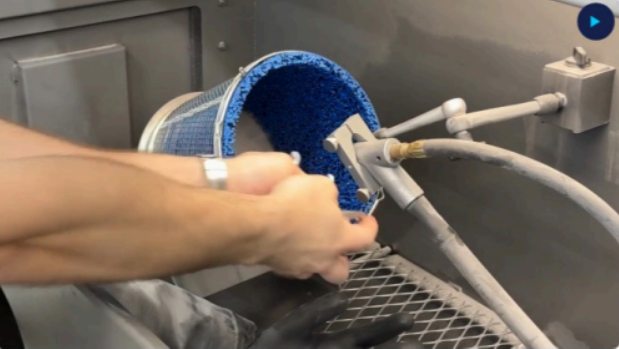
When turned on, the basket slowly rotates, tumbling the parts over each other while the blast gun continuously hits them with glass beads or other non-abrasive media. This tumbling action ensures that every surface of every part is exposed to the blast stream.
After 10 to 15 minutes, the operator returns to find a batch of perfectly clean parts with a uniform, satin MJF surface finishing. The operator was free to pack the next build, clean the
printer, or perform other high-value tasks while the parts were being processed.
Why Tumbling is Ideal for Powder Bed Parts
Powder bed fusion post processing requires a delicate balance. You need enough abrasive force to remove the caked-on powder, but not so much force that you alter the dimensional accuracy of the part or damage fine features.
Manual blasting often results in inconsistent finishes because the operator may hold the gun too close to one part and too far from another. The continuous, randomized movement of a tumble basket ensures that the media blast is distributed perfectly evenly across the entire batch. This results in a highly consistent 3D print surface finishing that is difficult to achieve by hand. You can explore the full range of automated blasting products to find the right fit for your workflow.
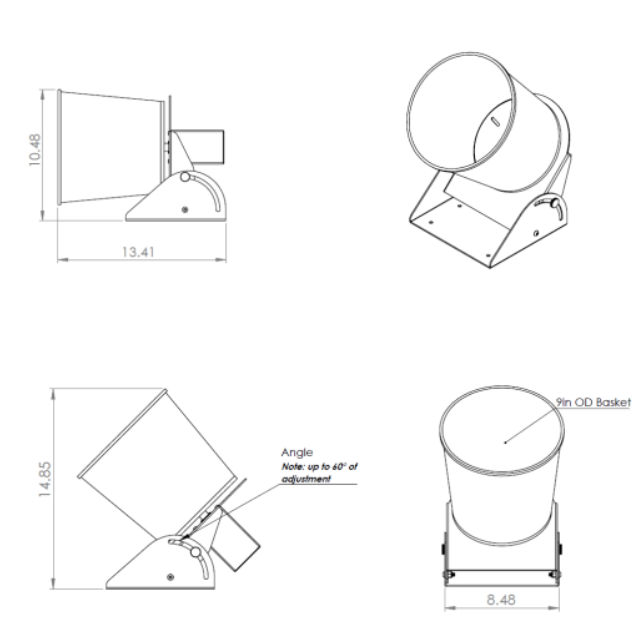
Specifications at a Glance
| Feature | Standard TumbleBlast™ |
| Price | $879 |
| Best For | Bead-blasting & non-abrasive media |
| Max Load | 10 lbs |
| Ideal Use Cases | SLS prints, MJF prints, machined parts, deburring |
| Cabinet Compatibility | Most free-standing and tabletop cabinets |
| Motor | Nema 17 stepper with digital speed control |
| Weight | 15 lbs |
Conclusion
For higher-volume operations or shops that need to handle sand-blasting media, the Giant TumbleBlast offers a larger stainless steel basket with 25 lb capacity. Either way, it is a rare example of a tool that pays for itself in labor savings within the first week of use.
Ready to Automate Your SLS Post-Processing?
The Standard TumbleBlast™ is in stock and ships in 1–3 business days. View the TumbleBlast →
