

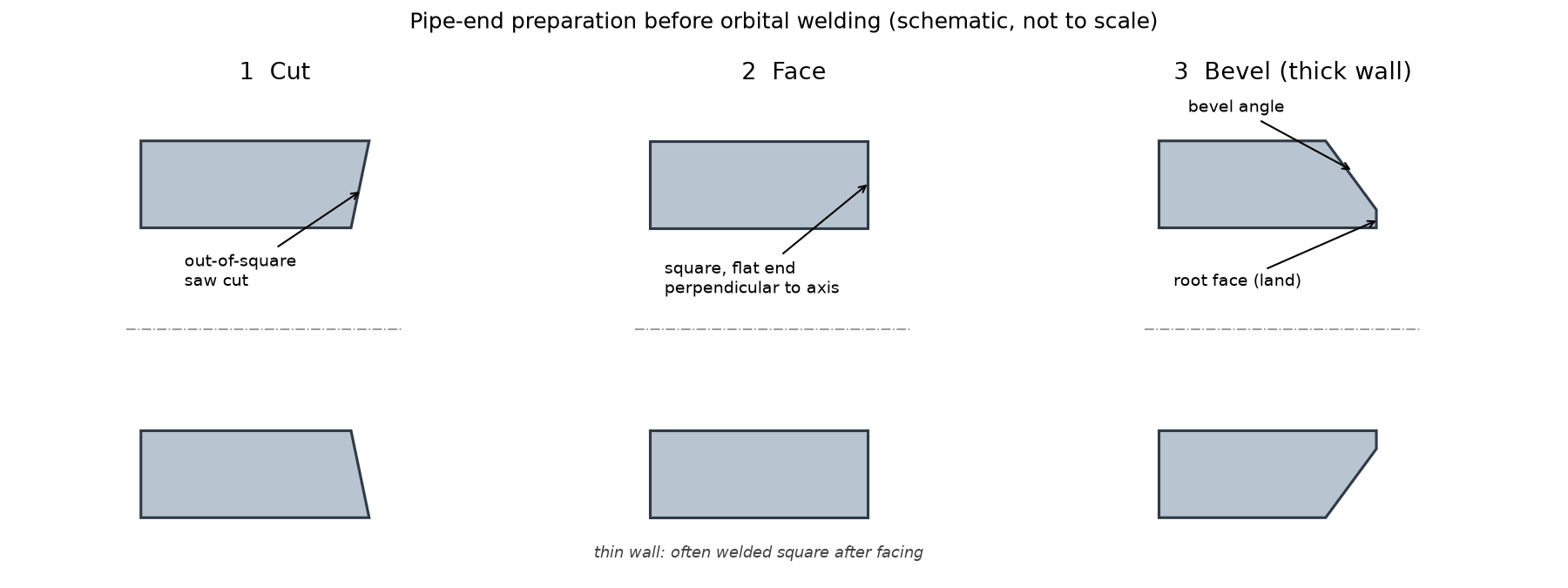
When an orbital welding project runs into trouble, the welding head is often the first thing questioned. In many cases the problem started earlier, at the saw, the facing tool or the beveling machine. An automatic welding system repeats the parameters it is given; it cannot correct an end that is out of square, a bevel with the wrong angle or a land that varies around the circumference. For buyers, that makes the front end of the process part of the welding decision, not a separate purchase.
This article sets out the questions engineers and purchasing teams can ask about pipe cutting, facing and beveling before they specify an orbital or automatic pipe welding system for carbon steel and stainless steel work in energy, process piping and pressure applications.
1. What joint does the welding procedure actually require?
Start with the approved or intended welding procedure, not the equipment catalogue. The procedure defines the joint design: bevel angle, root face (land), root gap and allowable misalignment. Thin-wall tube is often welded with a square butt prepared by facing alone. Thicker pipe usually needs a bevel, and heavier walls may need a compound or J-profile prepared by a machine that can hold that geometry.
Buyers should write the joint down as numbers before comparing machines. A request that says only “beveling machine for 8-inch pipe” invites quotations that cannot be compared.
2. Which diameters and wall thicknesses must be covered?
List the real range of outside diameters and wall thicknesses on the project, and note which are most common. Front-end equipment is normally sold as a family of models, each covering a band of sizes. As an example from our own catalogue, external-clamping cut-and-bevel machines in the YDP family span roughly 20 mm to 1,230 mm OD, with standard wall capacity of 20 mm to 30 mm depending on model and heavy-duty versions rated higher. Internal-expanding ISY bevelers cover about 15 mm to 630 mm across eight models, with walls up to 20 mm, and PF facing machines cover tube from 6.35 mm to 168 mm OD across seven models.
The point is not the numbers themselves but the method: map each joint on the isometric drawings to a model, and check that the welding system covers the same band. Our K-series open-type welding system, the FXT40 Pro, is specified for pipe from 20 mm to 325 mm OD and walls from 2 mm to 12 mm, in carbon steel and 304, 316 and 316L stainless steel, with heavier
walls up to 20 mm requiring a custom configuration. If the front-end tools and the welder cover different ranges, the gap will show up on site.
3. Cut first, or cut and bevel in one setup?
Some projects saw pipe to length and bevel it separately; others use a split-frame or external-clamp machine that cuts and bevels in one clamping. A single setup reduces handling and the chance of losing squareness between operations, which matters for installed pipe where the joint cannot be rotated. Separate operations may suit a fabrication shop with a dedicated cutting line. Ask which arrangement the supplier recommends for each joint type, and why.
4. How accurate is the prepared end?
For automatic welding, consistency around the circumference matters more than nominal size. Ask suppliers to state bevel-angle tolerance and end perpendicularity, and how those were measured. Our external-clamp machines, for instance, are documented at a bevel-angle tolerance of ±0.5° and end perpendicularity of 0.1 mm or better. Whatever figures a supplier gives, ask whether they apply across the full diameter range and how the operator checks them in production.
5. Internal or external mounting?
Internal-expanding bevelers clamp inside the bore with self-centering jaws and are compact, which helps on short spools and tight installations. External-clamp machines grip the outside and are better suited to larger diameters, cutting and heavy walls. The choice depends on bore condition, available straight length and whether the pipe is already installed. Ask the supplier how much clear length each machine needs on either side of the cut.
6. Does the tooling match the material?
Tooling is a frequent source of disappointment. Standard high-speed-steel cutters suited to carbon steel are not necessarily the right choice for stainless steel, alloy steel or cast material. Ask which tool grades and angles are supplied as standard, which are needed for each material on the project, and how long a set is expected to last. Stainless steel joints also need a plan for avoiding contamination from tools used on carbon steel.
7. How long does preparation take per joint?
Throughput claims should be read carefully. Preparation time depends on diameter, wall thickness, material and drive power, and a single figure rarely applies to every joint. Ask for times on two or three representative joints from the project, and include setup and changeover, not just cutting time. Compare that with the expected welding cycle so the front end does not become the bottleneck.
8. Power, drives and site conditions
Confirm the available supply on site. Front-end machines may be offered with electric or hydraulic drives, and in single-phase or three-phase versions; some models support only one supply. The welding system has its own requirements: the FXT40 Pro, for example, runs on 380 V three-phase as standard with a 220 V single-phase option, and uses an air-cooled power source with a water-cooled welding head. Check generator capacity and cooling-water arrangements before mobilisation.
9. Can the supplier demonstrate on your joint?
The most useful test is a trial on representative pipe: the actual material, diameter, wall and joint design, ideally including the tightest access on the job. Prepare the end, measure it, weld it with the intended procedure and inspect it with the specified methods. A demonstration on an easy sample proves that the machines run; a demonstration on your worst joint shows whether the process works.
The front end is part of the welding system
Cutting, facing and beveling determine the starting conditions for every orbital weld. Buyers who specify the joint first, map sizes across all equipment, and test on representative pipe give their welding system a realistic chance of producing repeatable results. The questions above apply whichever supplier is chosen.
About the author
April Pei is Marketing Director at Hubei Feiyide Intelligent Equipment Co., Ltd. (FYID-Feiyide).
About FYID-Feiyide
Hubei Feiyide Intelligent Equipment Co., Ltd. (FYID-Feiyide) is a Chinese manufacturer of orbital and automatic pipe welding equipment and pipe-preparation machines, including cutting, facing and beveling equipment. The company has 51–100 employees. Website: fyid-feiyide.com
