

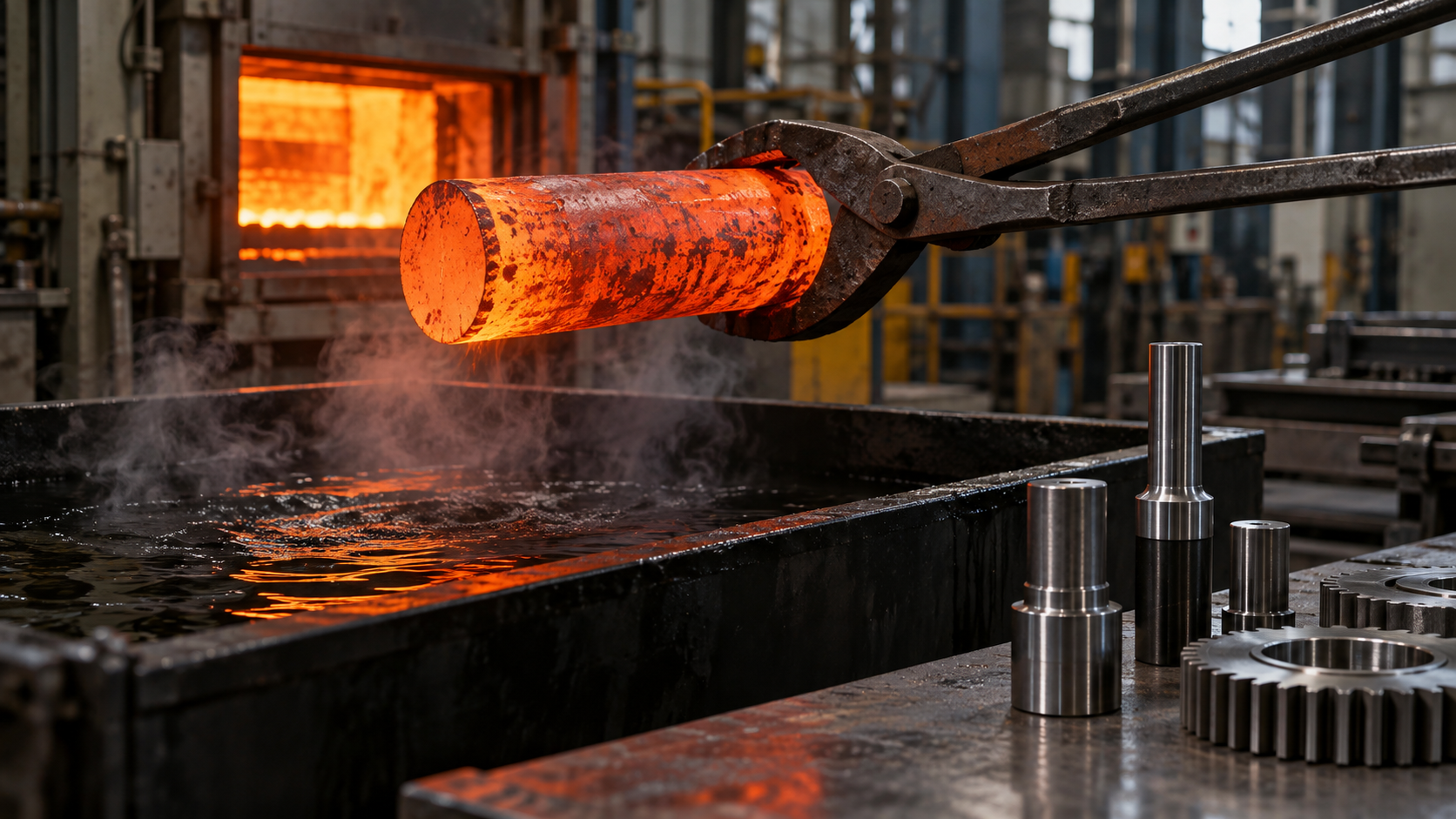
Take two steel punches machined from the same bar of 1095. Same dimensions, same finish, same job. The first chips under its first heavy impact. The second takes repeated strikes and keeps working.
The steel didn’t change. The heat treatment did.
Anyone who has machined tooling to a print that says HRC 58-60 knows the number matters. What the number doesn’t show is the path the part took to get there. For punches, dies, gears and cutting tools, that path can determine whether the steel resists wear, distorts under load, chips or cracks.
Hardness and Toughness Pull Against Each Other
Hardness is resistance to denting and wear. It helps cutting tools keep their edges and gear teeth resist surface damage. Toughness is resistance to cracking. A tough steel part absorbs impact or sudden loads without breaking. Push one up and the other usually comes down.
Carbon sets the ceiling for how hard a steel grade can get after quenching. That matters in tooling, where wear resistance calls for hardness, and in springs, where flexibility matters more. Owen from Battling Blades mentioned the same trade-off appears in working sword steels, which need a hard edge without becoming so brittle that they fail on impact. Heat treatment decides where within those limits a finished steel part actually lands.
The Quench Is Where Hardness Comes From
Heating steel past its critical temperature dissolves carbon into a structure called austenite. Cool it fast enough and the carbon gets trapped in martensite, which is extremely hard and, straight out of the quench, about as forgiving as glass. Cool it too slowly and the steel forms softer structures that may not meet a part’s wear or strength requirements.
Each grade wants its own quench. Water and brine are fast and harsh. Oil is gentler. Air-hardening tool steels like D2 harden in still air, which helps with distortion. Parts with uneven cross-sections pose an extra challenge: thin sections cool much faster than thick ones. That mismatch creates stresses that can cause warping or quench cracks in tools, shafts and other machined components. Overheating before the quench causes its own trouble. The grain coarsens, and the finished steel can become brittle no matter how carefully it’s tempered.
Tempering Buys Back Toughness
Quenched steel can be too brittle to put straight into service. Tempering reheats it to a much lower temperature, relieves internal stress and trades a slice of hardness for a large gain in toughness.
How much hardness goes depends heavily on the alloy. Plain carbon steels give it up steadily as the tempering temperature climbs. Higher-alloy grades hang on far longer. In a 2025 study of a D2-type tool steel, the material lost only about 23 percent of its as-quenched hardness after a 500°C temper, a temperature that would soften plain carbon steel dramatically.
Toughness doesn’t simply rise as hardness falls, either. Testing on a new carbon knife steel published in 2025 found toughness peaked at a moderate tempering temperature and dropped off on both sides of it. That matters when choosing a tempering schedule for any part that must handle impact or repeated loads. Many high-alloy grades also need two or three tempering cycles before they settle down.
A Hard Surface on a Tough Core
Not every steel part benefits from the same hardness throughout. Selective hardening makes the working surface resistant to wear while leaving other areas tougher. Traditional curved swords provide an early example: clay applied along the spine slows cooling there, while the exposed edge hardens during quenching. The wavy line between the two zones is called a hamon. In modern production, induction or flame hardening targets gear teeth, shaft surfaces or industrial blade edges. Keeping the core tougher helps those parts handle shock and bending without giving up surface hardness.
The Surface Is Where Good Heat Treat Goes Wrong
Two problems show up right at the surface, often exactly where wear and fatigue loads are highest.
The first is decarburization. In an uncontrolled furnace atmosphere, carbon migrates out of the surface and leaves a soft skin. On a shaft that might shave a little off fatigue life. On a punch, die or cutting edge, it can leave the first few thousandths of the working surface too soft. Leaving extra stock to grind away, wrapping parts in foil or using vacuum or controlled-atmosphere furnaces all help, and a microhardness traverse from the surface inward will show how deep any carbon loss goes.
The second is grinding after hardening. Friction heat builds quickly at thin edges and other concentrated contact areas, and once the surface passes its original tempering temperature it can soften the steel. Straw or blue discoloration can be a warning sign. Sharp abrasives, light passes and plenty of coolant help prevent it. A component can leave the furnace in perfect shape and still lose surface hardness at the grinder.
Where Cryogenic Treatment Fits
High-carbon and high-alloy steels can hold some retained austenite after the quench. It’s soft, and it can transform slowly later on, which shifts dimensions. Taking a steel component well below zero soon after quenching converts more of it to martensite. That can improve stability and wear performance in suitable grades. A recent study on a stainless knife steel found cryogenic treatment improved edge durability in standardized cutting tests by nearly 19 percent. It won’t rescue a bad quench, though, and lean carbon steels with little retained austenite gain less from it.
Checking What Came Out of the Furnace
A hardness number is the easiest check and the least complete one. Test on a flat, properly prepared surface rather than an edge or irregular area, and check more than one spot on long or complex parts. A Rockwell reading confirms whether the target hardness was reached. It says nothing about toughness, grain size or whether the surface got overheated during finishing.
For production work, write the whole path into the spec: steel grade, austenitizing temperature, quench medium, tempering temperature, number of cycles and the target hardness range. That path is what separates a punch that chips on its first heavy impact from one that keeps working through years of service.
Author Bio:
Owen Juarbal manages content and marketing for Battling Blades, helping share the craftsmanship, history, and culture surrounding swords and knives. He brings a practical, enthusiast-focused perspective to his writing.
