

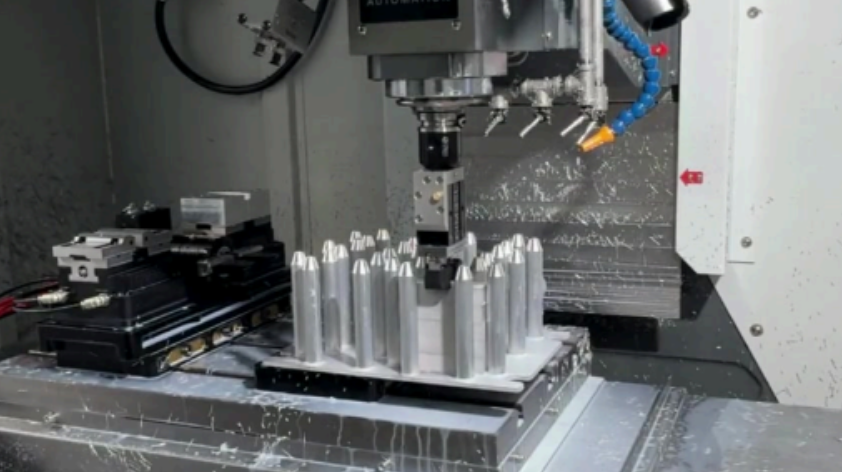
Two-operation parts are the backbone of CNC machining. You machine the top in Op1, flip the part, then machine the bottom in Op2. It is the most fundamental workflow in any job shop or production cell. Yet it is also the single hardest workflow to automate.
The conventional answer is a cobot or industrial robot: a 60, 000–150,000 investment that picks the part out of the vise, carries it to an external flip station, flips it, and places it back. The robot needs guarding, programming, integration engineering, and months of commissioning. For shops running 1,000-piece lots or fewer, the ROI math rarely works.
But what if you could automate both operations in a single unattended cycle — without a robot, without external stations, and without leaving the machine enclosure?
The Problem with Traditional Two-Op Automation
Traditional CNC two-op automation requires multiple pieces of equipment working in concert outside the machine:
A robot or cobot picks the part from the Op1 vise, moves it to an external flip station (often a pneumatic rotary table or gravity flipper), waits for the flip, picks it back up, and loads it into the Op2 vise. This creates several failure points: the robot must be precisely calibrated to two different vise positions, the external flip station adds another pneumatic device to maintain, and the entire system occupies valuable floor space beside the machine.
For a typical vertical machining center, this means dedicating 4–6 feet of floor space to a robot pedestal and flip station — space that most shops simply do not have.
The In-Machine Alternative: GripFlipGrip5™
Gimbel Automation took a fundamentally different approach. Instead of moving the part outside the machine to flip it, their GripFlipGrip5™ Pallet keeps everything inside the CNC enclosure. The entire two-op workflow — load, machine Op1, flip, machine Op2, unload — happens in a single cycle without the spindle ever stopping for human intervention.
Priced at $8,849 (with 100mm vises), the GripFlipGrip5™ is the fifth iteration of this system and has been widely adopted for both spindle gripper and robotic machine-tending applications.
What Is the GripFlipGrip5™?
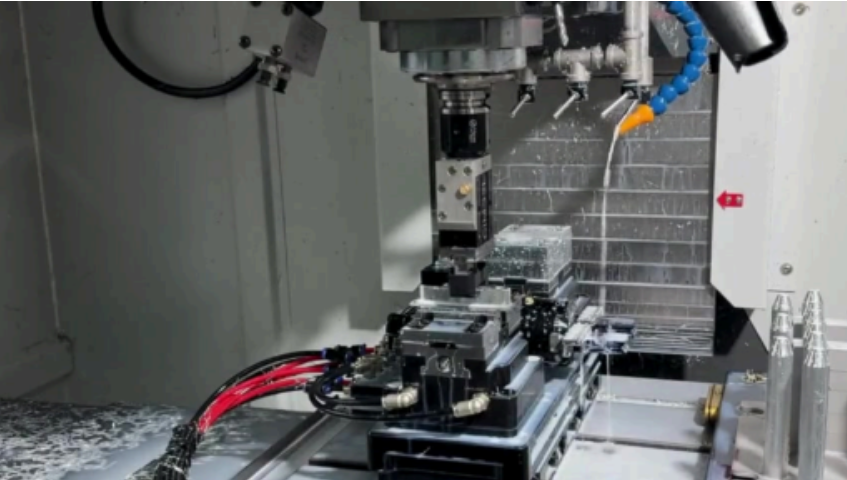
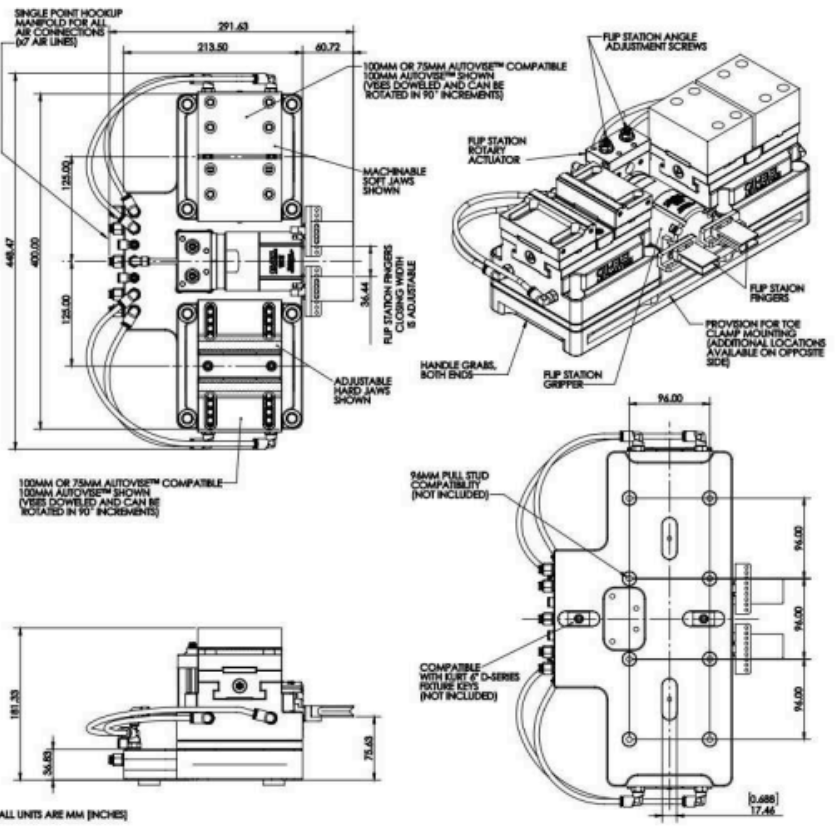
The module is a single integrated pallet that bolts to your machine table. It contains three critical subsystems on one manifold base:
- Op1 AutoVise™ — A self-centering pneumatic vise that clamps raw stock for the first operation
- Integrated QuickFlip180™ Station — A pneumatic part-flipping mechanism built directly into the pallet
- Op2 AutoVise™ — A second self-centering pneumatic vise with machined soft jaws that receives the flipped part for the second operation
All air routing is integrated through the pallet itself — seven air lines exit the front of the module
and connect to solenoid valves controlled by your CNC program’s M-codes.
The 5-Step Automated Workflow
Here is exactly how the GripFlipGrip5™ completes a full two-operation part in a single unattended cycle:
Step 1: Gripper Loads Raw Stock into Op1 Vise
The cycle begins with a GimGripper™ spindle gripper (or GimVac™ vacuum gripper) picking up a piece of raw stock from the loading tray. The gripper is held in the spindle just like a tool — no robot arm required. The CNC program commands the spindle to move to the Op1 vise position, the gripper places the stock, and an M-code fires the solenoid to clamp the vise.
The Op1 AutoVise™ clamps with 900–3,400 lbf of force at 0.0008” repeatability. The gripper returns to the magazine, a cutting tool loads, and Op1 machining begins.
Step 2: Gripper Grabs the Part, QuickFlip™ Flips It
After Op1 machining completes, the gripper tool loads back into the spindle. It picks the semi finished part out of the Op1 vise (which opens via M-code) and moves it to the integrated QuickFlip180™ station in the center of the pallet.
The QuickFlip180™ leverages the remaining “top hat” (uncut stock material) on the part. The gripper places the part into the flip station fingers, releases, and the station pneumatically rotates the part exactly 180 degrees. The gripper then re-grabs the now-flipped part from the other side.
Step 3: Flipped Part Loaded into Op2 Vise and Machined
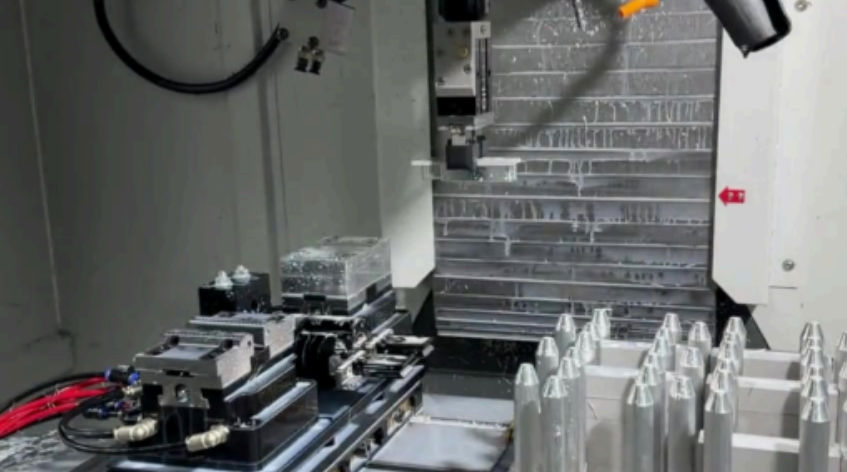
The gripper carries the flipped part to the Op2 vise, which features machined soft jaws profiled to the Op1-finished geometry. The part drops into the jaws, an M-code clamps the vise, the gripper returns to the magazine, and Op2 machining begins.
When Op2 completes, the part is 100% finished — both sides fully machined, ready to ship.
Step 4: Automated Repeating Production
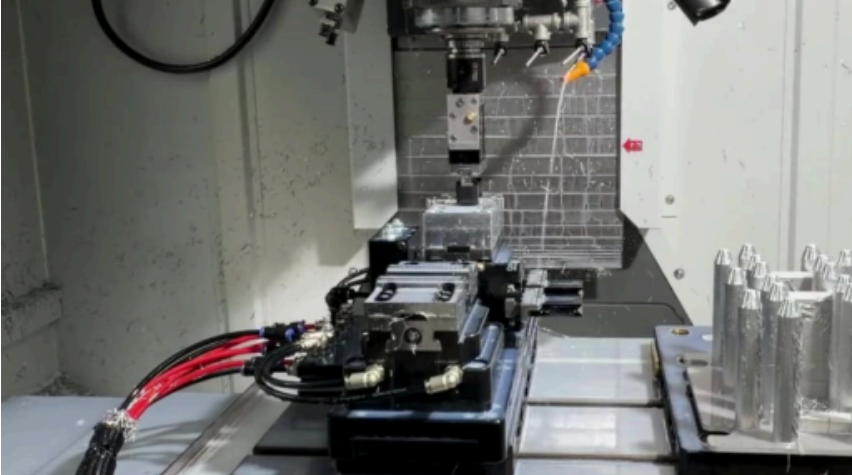
The gripper unloads the finished part back to the loading tray, picks up the next piece of raw stock, and the entire cycle repeats. This continues unattended until the entire tray is full of finished components.
Step 5: Reload the Stock Tray
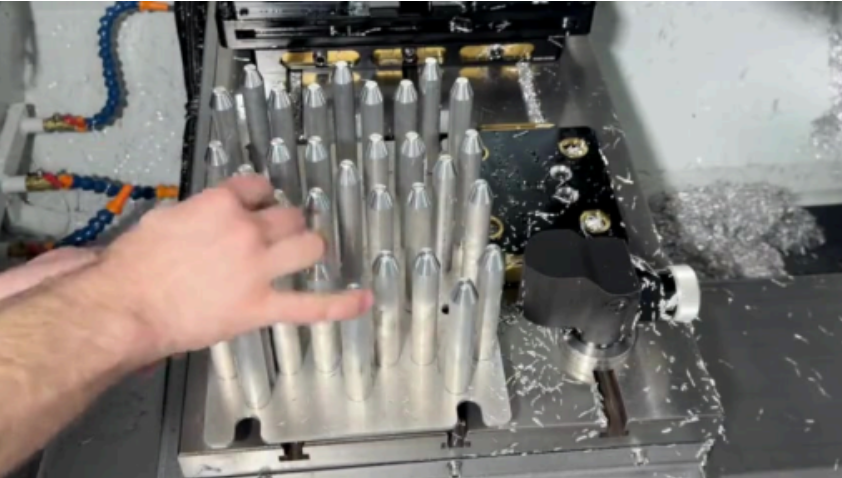
When the operator returns, they simply remove the finished parts and drop in new raw stock. Because the loading tray uses alignment pins (no clamping), reloading takes less than 5 seconds per part.
Technical Specifications
| Specification | Value |
| Price | 8, 849(100mm)/
8,749 (75mm) |
| Vise Repeatability | 0.0008” |
| Vise Clamping Force | 900 – 3,400 lbf |
| Clamping Width Options | 75mm or 100mm |
| Recommended Air Pressure | 100 psi |
| Max Air Pressure | 130 psi |
| Pallet Height | 6.2” |
| Total Weight | 65 lbs |
| Air Lines | 7 (controlled by 4 solenoids) |
| Zero-Point Compatibility | 96mm pullstud pattern (5th Axis compatible) |
What You Need to Complete the System
The GripFlipGrip5™ pallet is the workholding and flipping core, but a complete automated cell also requires:
Spindle Gripper or Vacuum Gripper — A GimGripper™ or GimVac™ to handle part loading/unloading via the spindle
Solenoid Control — Two MCodeAir™ Kits ($929 each) to provide the four solenoid channels needed to actuate both vises and the flip station
Macro Programming — Gimbel provides comprehensive macro templates for Haas, Brother, Fanuc, and DN Solutions machines. Programming is as simple as replacing the M30 at the end of your posted code with an M99.
For shops that want a complete turnkey solution, Gimbel offers Two-Op Bundles that include the pallet, grippers, solenoids, and full programming support. They also offer Turnkey Direct™ services for shops that want hands-off implementation.
Why This Beats a Robot for Most Shops
| Factor | GripFlipGrip5™ | Cobot + External Flip Station |
| Total Cost | ~$12K (pallet + grippers +
solenoids) |
60K–
150K+ |
| Floor Space | Zero (inside machine) | 4–6 ft beside machine |
| Installation
Time |
Hours | Weeks to months |
| Programming | Macro template provided | Custom robot programming |
| Guarding | None (inside enclosure) | Safety fencing or force
limiting |
| Swap Time | Minutes (toe clamps) | Permanent installation |
The GripFlipGrip5™ is not a replacement for a robot in every scenario. If you are running 10,000+ identical parts 24⁄7 on a dedicated cell, a robot may still make sense. But for the vast majority of job shops and production shops running mixed parts in 50–2,000 piece lots, the in machine approach delivers the same unattended capability at a fraction of the cost and complexity.
Conclusion
Two-op automation does not require a six-figure robot investment. By keeping the entire workflow inside the machine enclosure — load, machine, flip, machine, unload — the GripFlipGrip5™ eliminates the need for external flip stations, robot pedestals, and safety guarding. It is the fastest path from manual two-op production to fully unattended manufacturing.
Ready to Automate Your Two-Op Parts?
The GripFlipGrip5™ is in stock and ships in 1–3 business days.
