

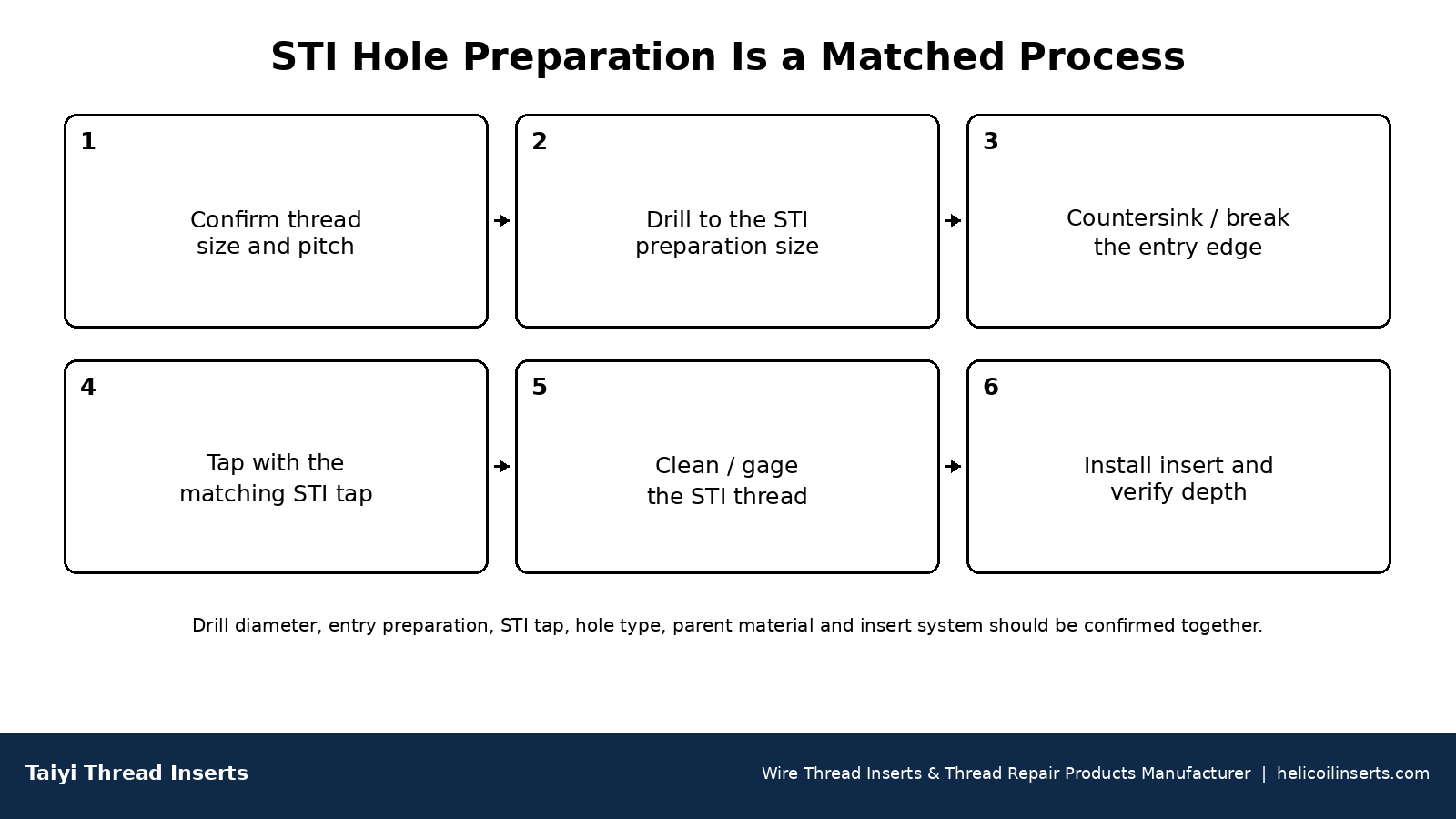
A wire thread insert begins with a hole that looks familiar but follows a different machining logic. The most common preparation mistake is to choose a drill from a conventional tap-drill chart simply because the finished internal thread is, for example, M6 x 1.0 or 1/4-20 UNC. That approach overlooks the role of the STI tap.
An STI, or Screw Thread Insert, tap does not cut the final thread that the mating screw will use. It cuts the larger installation thread in the parent material. The wire insert is then installed into that thread, and the insert itself provides the finished internal thread. As a result, the preparation drill, STI tap, insert system, parent material and available hole depth need to be treated as one process rather than as independent choices.
The preparation drill is system-specific
Published insert-system data illustrates why a single “universal” STI drill size can be misleading. In STANLEY Engineered Fastening’s Heli-Coil HC2000 Rev. 12 catalog, the suggested drill for M6 x 1.0 is 6.25 mm in aluminum and 6.30 mm in steel, magnesium or plastic. For M8 x 1.25, the catalog lists 8.30 mm for aluminum and 8.40 mm for the other material group.
The differences are small, but the pre-tap hole affects tapping load, the resulting STI thread geometry and the amount of material left for thread formation. The practical rule is therefore to confirm the drill recommendation against the actual STI tap and insert system being used, rather than copying a number from an unrelated chart.
Hole geometry matters as much as diameter
Through holes and blind holes also change the tooling decision. A spiral-point STI tap is commonly suited to through-hole work because it pushes chips forward. A spiral-flute tap can be useful in blind holes because it draws chips back toward the entry. Straight-flute STI taps remain a practical option in many maintenance, repair and short-run operations.
Blind holes add another constraint: drilling depth. Enough depth is needed not only for the insert, but also for full STI thread engagement, tap chamfer allowance, insert set-down and drill-point clearance. A hole can have the correct diameter and still fail during installation if the tap bottoms before sufficient full-form thread is produced.
A simple shop-floor selection sequence
- Identify the original thread standard, nominal diameter and pitch.
- Confirm whether the receiving hole is through or blind and measure usable depth.
- Identify the parent material and select an STI tap style that suits the hole and chip flow.
- Use the current drill recommendation for the specific insert/tap system.
- Plan drilling and tapping depth before machining a blind hole.
- After tapping, clean the hole and use the appropriate STI gage where controlled fit is required.
- Install the insert and verify installation depth and screw engagement.
The main point for machinists
STI tap-drill selection is not a standard-thread lookup with a different tap added afterward. The drill establishes the starting geometry, the STI tap creates the installation thread, the hole geometry determines usable engagement, and the wire insert creates the final internal thread. A mismatch at the first step can carry through the entire operation.
For production work, repair kits and repeat maintenance programs, the most reliable approach is to define the drill, STI tap and insert as a matched package and verify the combination in the actual parent material. That produces a more repeatable process than relying on nominal thread size alone.
Technical reference: Taiyi maintains a practical STI tap-drill chart covering metric preparation sizes and the relationship between the preparation drill, STI tap and wire insert: https://helicoilinserts.com/helicoil-tap-drill-chart/
Source note: Representative drilling examples above are based on STANLEY Engineered Fastening, Heli-Coil Catalog HC2000 Rev. 12, Table VI. Always confirm current data for the exact insert and STI tooling system in use.
About the author: Jack Zhang is with Taiyi Thread Inserts, a manufacturer focused on wire thread inserts and thread repair products. https://helicoilinserts.com/
