


Waterjet cutting is one of the world’s most rapidly evolving primary machine tools. Waterjets can cut almost anything. Businesses of all sizes and types integrate them in their operations to achieve improved efficiencies and productivity.
In the 1970s, waterjets were used to cut soft materials such as cardboard. But, later in the mid-1980s, the tool’s capacity was maximized to cut the hard materials. This fundamental concept is both easy to understand and complex. It’s easy to understand, use, and conserve. On the other hand, the procedure involves the highly complicated design and material.
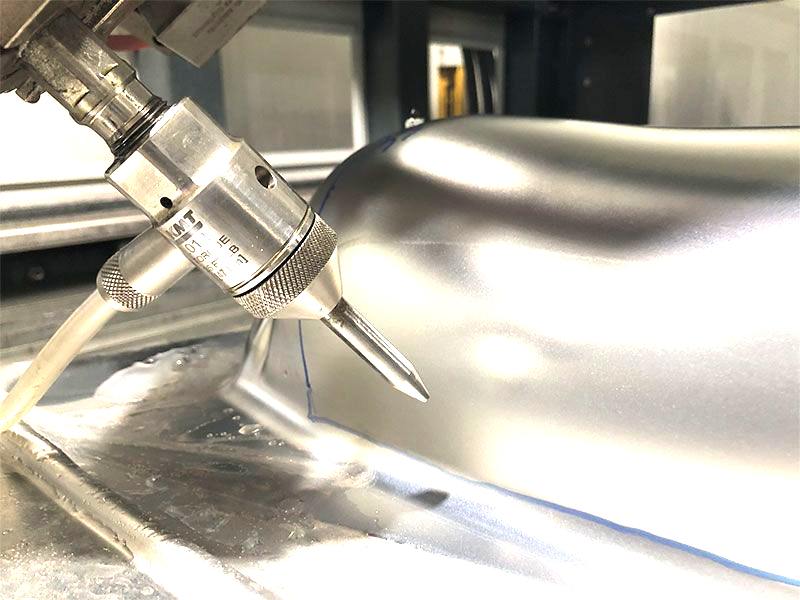
Waterjet cutting is an engineering technique that uses the energy of high-speed, high-density, high-pressure water to cut objects. An ultrahigh-pressure pump pressurizes the water, which comes out of a small nozzle with a speed of about three times that of sound.
Kinds of Waterjet
Pure Waterjet machines and abrasive waterjets are the two sorts. The machine can cut practically any material, shape, and thick objects when used together.
- Pure Waterjet: Soft materials, such as foam, paper, cloth, carpet, food and other similar soft things are cut using a pure waterjet.
- Abrasive Waterjet: Hard materials, such as metal, ceramic, stone, glass, and composite, are cut using an abrasive waterjet. When abrasive is added to a supersonic waterjet stream, the cutting power is multiplied significantly.
The abrasive is introduced at the nozzle, allowing for a quick switch between pure water and abrasive cutting.
Nine Steps of Action
Step 1 Pump (Hydraulic):
Water is circulated from the reservoir tank through the hydraulic pump during the machining process. At low pressure of roughly 5 bars, water is directed into the intensifier using a pump. Further, a booster enhances the starting water pressure to 11 bar before moving to the intensifier.
Step 2 Intensifier (Hydraulic):
The intensifier increases the water pressure from 5 to 3000 to 4000 bars. The intensifier’s high-pressure water is directed to the nozzles and the accumulator.
Step 3 Accumulator:
It stores high-pressure water and makes it available whenever needed. It’s used to prevent high-pressure machining of hard materials from fluctuating.
Step 4 Mixing Tube:
Abrasive particles and water are merged in the mixing tube.
Step 5 Control Valve:
It controls the pressure and direction of the water jet.
Step 6 Flow Valve:
Water’s flow is controlled using a flow valve.
Step 7 Nozzle:
High-pressure water moves to the nozzle, which converts the water’s high-pressure energy into kinetic energy. A narrow beam of water with a high velocity (1000 m/s) emerges from the nozzle. Within the nozzle, abrasive material like garnet is combined with water. The high-pressure water is mixed up with abrasives in a mixing chamber in the nozzle.
Step 8 Cutting the object:
When water with high-velocity contacts the surface, it cuts the material.
Step 9 Drain System:
The catcher system collects the water jet after machining. The garbage and metal particles in the water are eliminated here.
Benefits
- It is capable of cutting materials preventing structural damage
- It can cut objects sophisticatedly and minutely
- The surroundings remain clean during the waterjet cutting process
- Because of the fixed machine parts, it bears a very nominal maintenance cost
- Because no heat is generated, the objects are prevented from damage
- It can cut both softer and more complex materials such as rubber, plastics, and wood (WJM) as well as stone (AWJM)
- It does not become toxic to the environment as it does not generate pollution
- Machining accuracy is relatively high
Drawbacks
- Soft objects can be cut easily. Contrary to this, more rigid materials having only limited thickness are dealt with by the AWJM
- WJM incurs a weight cost at the start
Application
- Water jet machining can be used for cutting, shaping, and reaming processes in various industries, including mining, automotive, and aerospace
- Rubber, plastics, foam, leather, stone glass, food, metals/paper, and many more materials are widely machined by water jet (AWJM)
- WJM is primarily used to cut soft materials; thin strips, woods, fabrics, composites, polymers, leathers, etc
- WJM is often used to machine materials that are difficult or impossible. It’s used to cut thick steel, aluminum, and other industrial elements, reinforced plastics, metal matrix, multilayer composites, stones, and glass, among other materials
- Aside from machining, high-pressure water jets are used for paint removing, surgery, cleaning, and peening to eliminate residual stress, among other things
- The AWJM can also be used for drilling, turning, and reaming
Conclusion:
In the end it is concluded that waterjet cutting has become the biggest tool in today’s era. If you’re thinking about buying one, this article is going to be very helpful for you to understand the points to consider.

209 Comments
Everything you need to know https://social.japrime.id/read-blog/598122
Афиша театров https://rest.kiev.ua и концертов в Киеве: что выбрать и куда пойти
RustCraft https://rustcraft.ru всё об игре Rust: подробные гайды (guides), полезные bind-команды, секреты выживания (survival), строительство баз (base building), крафт (crafting), PvP, raid и farming. Советы для новичков и опытных игроков, тактики рейдов, настройки игры, оружие и игровые механики.
I appreciate how this post stays balanced and organized while also keeping the discussion relaxed and engaging overall.
casino italiani non aams
Дані-інфо https://dani-info.com – новинний сайт Балаклії. Тут публікують події міста й громади, новини Харківщини та корисні матеріали для мешканців.
Провінція https://provintsiya.com.ua/ це міський новинний сайт Вінниці. Тут публікують події міста й області, рейтинги закладів та корисні матеріали для мешканців.
Discover the cutting-edge naked ai app AI nude generator. Quickly remove clothing from photos using next-generation neural networks. Highly realistic and confidential.
An innovative free ai undress AI generator for removing clothing from photos. High-quality detail, complete privacy, and instant processing. Try it for free!
Нужны публикации в сми для geo? Размещаем экспертные статьи на 200+ трастовых площадках. Нейросети цитируют ваш бренд в ответах ChatGPT и Яндекс Нейро. Публикации в СМИ для GEO дают рост доверия LLM.