

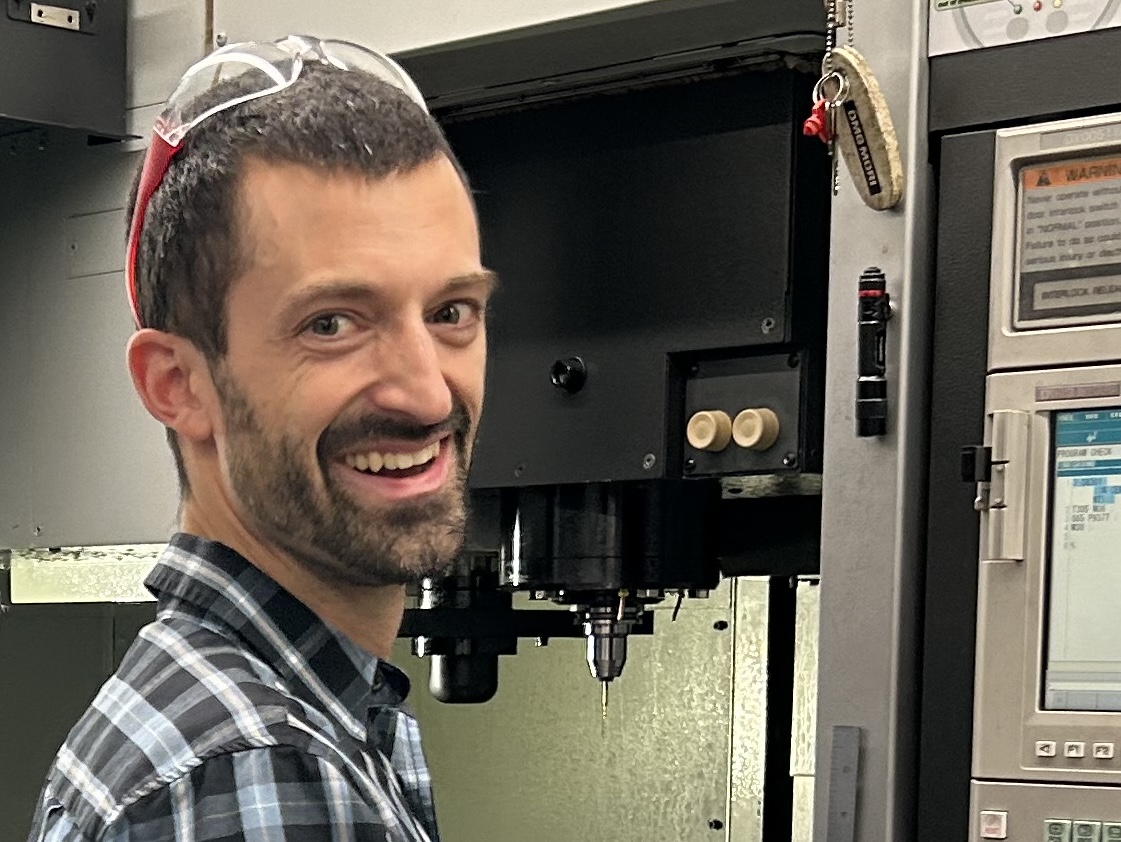
What happens when a mechanical engineering instructor actually comes from industry—not academia?
My guest on today’s podcast is Andrew Schiller from Utah Tech, who spent six years at Caterpillar and GE, and studied theology at seminary, before landing in the classroom. He’s teaching students to think like business owners—understanding costs, not just making parts. But more than that, his students aren’t just learning to push buttons, they’re falling in love with creating things that actually matter.
*************
Listen on your favorite podcast app using pod.link.

 .
.
View the podcast at the bottom of this post or on our YouTube Channel.
Facebook: https://www.facebook.com/swarfcast
Instagram: https://www.instagram.com/swarfcast/
LinkedIn: https://www.linkedin.com/company/todays-machining-world
Twitter: https://twitter.com/tmwswarfblog
*************
Link to Graff-Pinkert’s Acquisitions and Sales promotion!
*************
Interview Highlights
Andrew’s Story
Andrew’s path to teaching wasn’t planned. He grew up around his dad’s model-making shop in Chicago, spending countless hours around mills and lathes. “He’s a professional model maker and has a shop,” Andrew told me, describing how that hands-on foundation shaped his interest in making things.
After studying mechanical engineering at Valparaiso University, he spent six years at Caterpillar managing technical relationships with suppliers making starters and alternators. He visited manufacturing facilities, did failure analysis, and worked with product groups across the company. Then life took an unexpected turn.
“We went to Louisville, Kentucky. I started studying for a master’s degree in theology and worldview,” Andrew explained. While studying Greek and theology at seminary, he worked at GE Appliances on their FirstBuild team, designing products like the Forge Clear Ice Maker. He was juggling full-time graduate studies, 20-25 hours of work, and renovating a house. It was a pace that proved unsustainable with a young family.
The path to teaching at Utah Tech happened through pure serendipity. “I literally typed in engineering jobs in St. George, Utah,” Andrew said about a random search while planning a Zion National Park vacation. “The very first thing that came up was the description of the job that I do now.”
What He Teaches
His modern machining course teaches students to understand manufacturing from a business perspective. “We’re going to teach about machining processes, not as a craft project that you could do in your garage, but as if you were running a business with a bunch of people and had to make money with a very expensive asset that’s a machine.”
“I really realized there is a huge need in the industry for a different kind of education about machining. It’s not a crash course for machinists. It’s a science and business course for engineers.”
The program operates on a shoestring budget. Andrew has $160 per student for the entire semester. But that constraint hasn’t stopped him from creating something unique. Students learn hands-on machining while thinking strategically about the business implications of their decisions.
“I love having new conversations with people in the industry. It’s how I learn. It’s how I keep our curriculum relevant,” Andrew said. He stays connected to real manufacturing needs by constantly talking with industry professionals.
His Purpose
Andrew discovered something companies have been telling him consistently: “We need people who they’re not just bodies, but they’re passionate about this industry.” Traditional engineering programs weren’t addressing this gap.
His goal goes beyond teaching technical skills. As Andrew puts it, he’s passionate about machining and thinks “it’s cool,” but what really drives him is inspiring that same enthusiasm in students. The companies he talks with are “very excited” about what Utah Tech is doing differently.
At 35, with three kids and working 60-65 hours a week, Andrew has found his calling in bridging the gap between academic theory and manufacturing reality. He’s not just producing more engineers. He’s creating people who genuinely care about the industry and understand what it takes to succeed in it.
Podcast: Play in new window | Download

3 Comments
You have one part backwards. Machines are the relatively cheap part. People are the expensive and most important factor. They have to be hired, trained, managed, and paid enough to buy their time and skills in a competitive world. Demographics are making cheap labor a thing of the past world wide (even in China).
Prof Oscar Rath !
Taught me tool and die making at NY City Tech.
An old school Die Maker from Europe.
ON NONSENSE – if your work was sub par, he would drop it onto the floor, turn and walk away whilst muttering some choice words under his breath. On an occasion on a hot summers day he would toss your part right out an open window if you REALLY sucked.
Those days are gone, no more perfection and high standards.
We work towards the LOWEST common denominator.
We don’t want to hurt “feelings”.
Now we have “equity” where everyone can be equally useless…
we are entering into the end or another The Tytler Cycle
often cited as a 200-year cycle of civilization decline
It describes how democracies fall to dictatorship through eight stages:
Bondage
Spiritual Faith
Courage
Liberty
Abundance
Selfishness
Complacency
Apathy
Dependence
Bondage.
It posits that, over time, increased prosperity leads to greed, social decay, and a loss of freedom
Lather, rinse repeat…
I’m interested to know if and how Andrew’s theological studies inform and impact his present work.