

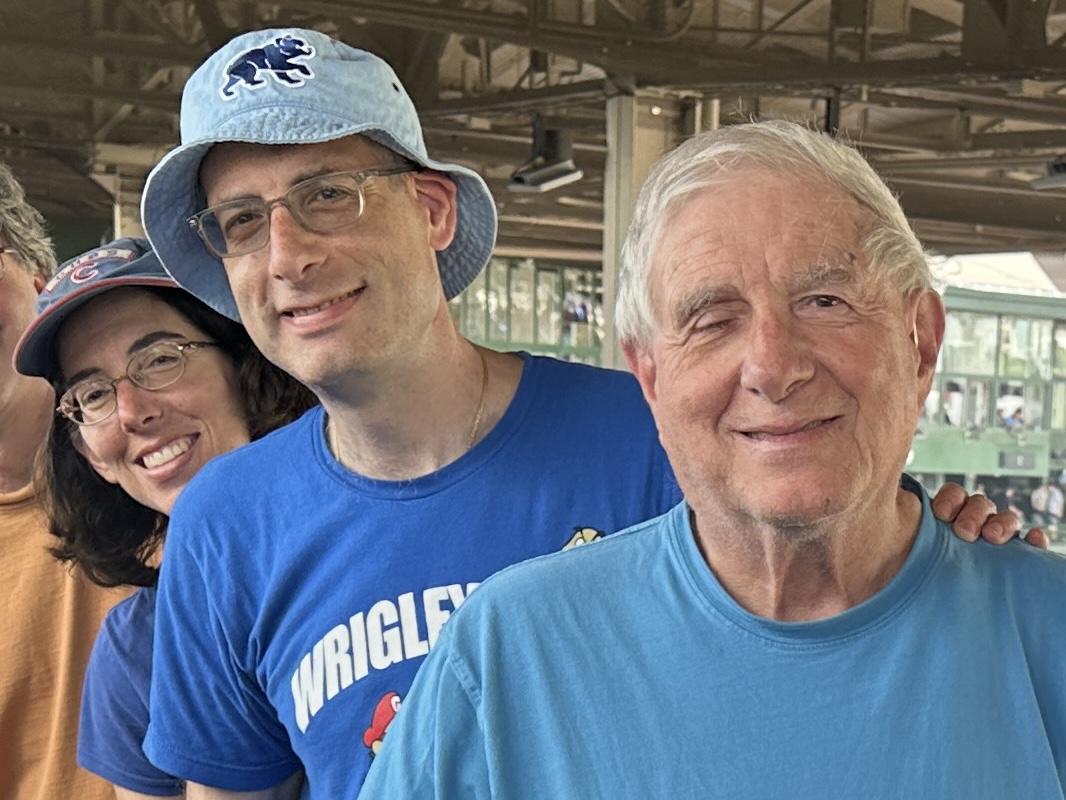
Eighteen years ago today, the Cubs were playing Houston, and Ryan Dempster was pitching.
I remember hearing the game on the radio as they were wheeling me into the operating room for a quadruple heart bypass to save my life. At least I think I heard it, or imagined hearing it. Since I was five years old, the Cubs have been knitted into my cerebral cortex, so even if I was unconscious, I may have somehow imagined Dempster on the mound against Houston.
Why do I care so much about the Chicago Cubs? Why do I study the batting order for almost every game and know the histories of even the most insignificant players? Why do I respond so viscerally to an error, a pop-up with runners on base, or a stupid throw by an outfielder to home plate when he should have thrown to third?
I’ve thought about this passion for the Cubs a lot lately as they scuffle through another pennant race. They are a good team but clearly well behind Milwaukee and probably the Dodgers. Yet this does not diminish my ardor. It just increases my pain.
I grew up with the Cubs. My mom was an avid fan. She got it from her dad and walked to Wrigley Field as a teenager. And her father’s mom had a liquor store near the old Cubs park and sold booze to Tinker and Evers and Chance, the 1908 double-play combination that won the World Series.
And now my children and grandkids share the love. My daughter, a rabbi in California, has made a reference to me and the Cubs in every Yom Kippur sermon she has given. This one will be the 25th.
I think we desperately need teams, symbols, religions, values, families that give us an identity and make for a community.
For the Graffs, the Cubs help do that. When Noah and I need a break from business, we often discuss the Cubs. It’s a beautiful diversion. Now he is starting to talk to his own son about them.
The Cubs are also an intellectual outlet for me. I can talk Fauci and Trump and El-Sayed with people who think they know something, but I’d rather discuss the Cubs.
I know the discussion won’t turn vicious. It’s baseball, but it can be intellectual and nuanced. How does Milwaukee find a kid like Jacob Misiorowski, who can hurl a fastball at 105 mph and still throw a slider at 94 over the inside corner at the knees, while the Cubs can’t put together a quality bullpen?
Baseball is a lot like business. Failure is a constant. A great hitter gets on base four times out of 10, including taking walks or getting hit on the shin by the pitcher. A pitcher averages 95 mph on his fastball, and the target he’s throwing to is about three inches wide, the width of the ball itself. Miss by that much and he’s vulnerable.
Pitching academies with computers and three-dimensional cameras teach pitchers their optimal mechanical throwing motions, and that has enabled them to average 2 mph higher than 10 years ago.
What is really great about being wrapped up in the Cubs is that failure isn’t the end of the world. I love my Cubbies, but if they lose, there is another game tomorrow, or even next season.
And then there is one more remarkable thing to report. After 56 years of marriage and of enduring my devotion to the Cubbies, my wife Risa is finally becoming a Cub fan. She’s beginning to see the beauty of a leaping catch or a majestic home run off a sizzling fastball. She’s questioning me about strategy and how a catcher can play nine innings in a crouch.
It has brought a completeness to my life I doubted I’d ever see. And now we sing “Go Cubs Go” together after a win. Amen.
Question: Who got you into your team, and who did you pass it on to?

3 Comments
My grandfather was a die-hard Cubs fan for life, and he shared that passion for the team with me. He kept a notebook with ALL the team’s stats (before the good ol’ internet was around to track it for us) as well as what happened every game. Growing up in a multi-generational household, I loved helping him carefully write in the details after each game during the summer. I attended a few games with my dad as a kid, though it wasn’t as much fun as just watching it on TV with my grandad!
Ridgely, I loved your comment. Buy me some Peanuts and Cracker Jack, I don’t care if I ever come back
Used to sing that with my granddad every 7th inning stretch, right along with Harry Carry!