

Open your fridge and grab a beer without knocking anything else over. It’s usually not hard for a human to do it. But getting a robot to do the same task can take an engineer weeks or months.
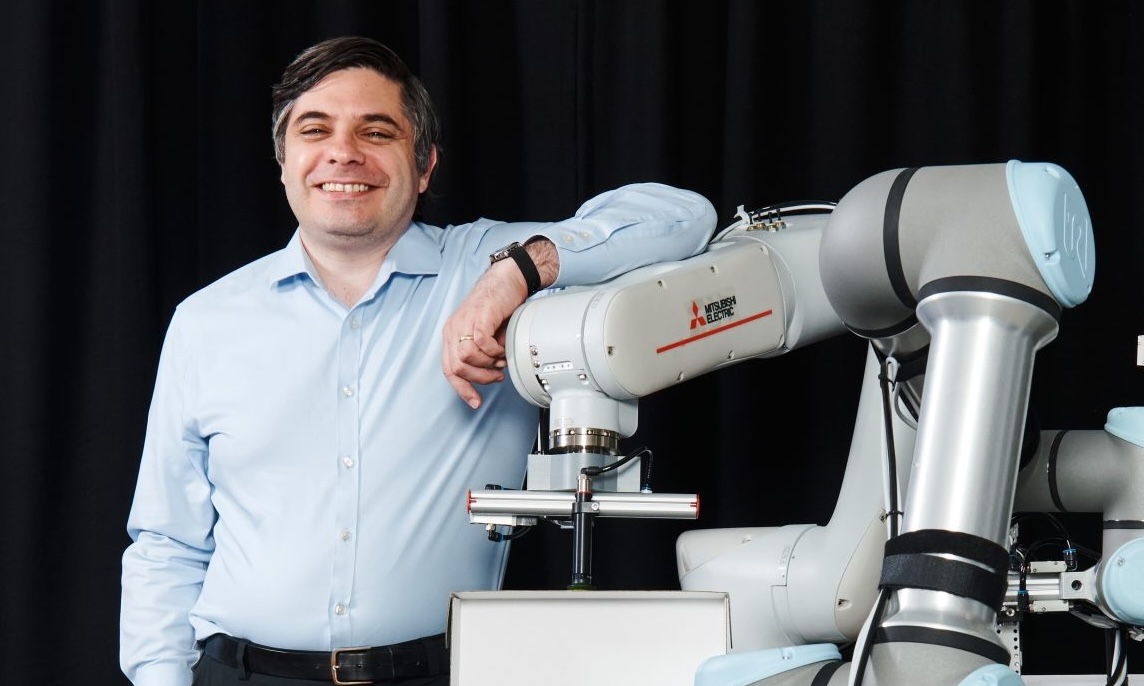
George Konidaris is a professor of computer science at Brown University, director of the Intelligent Robot Lab, and cofounder of Realtime Robotics. Their technology does that kind of motion planning in minutes instead of weeks, and it’s running on the manufacturing lines of major automakers right now.
He was on the show three years ago, when the technology worked in the lab. A lot has changed. The company closed a 45 million dollar Series B and is cash flow positive. (Blog continues below video)
********
Listen on your favorite podcast app using pod.link.


Facebook: https://www.facebook.com/swarfcast
Instagram: https://www.instagram.com/swarfcast/
LinkedIn: https://www.linkedin.com/company/todays-machining-world
Twitter: https://twitter.com/tmwswarfblog
*************
Link to Graff-Pinkert’s Acquisitions and Sales promotion!
*************
Main Points
Grabbing a beer is harder than it looks
Real Time came out of research George and his colleagues did on robot motion planning, which is how a robot decides on its own how to move without hitting anything.
“There are many ways in which you could reach into your fridge and grab a beer where you would hit the fridge or a beer or knock something over and you don’t do any of those.”
You solve that without thinking. For a robot it’s a hard computational problem, and the first paper posing it was written in 1979. What George and his collaborator found was a way to solve it in milliseconds instead of seconds or minutes. The original breakthrough needed a custom processor. It runs in software now.
Robots are still stupid, but less so
Last time he was on, he told me robots are stupid. I asked if that’s still true. They’re getting smarter and still stupid in surprising ways. Computer vision has genuinely improved. Put a robot in one room and ask it to find the door, then put it in a different room and ask again, and that works now. It used to be brittle.
Two and a half years versus five
Going from a car design to selling the first hundred thousand units takes an American or European automaker about five years. Chinese automakers do it in two and a half, regularly. The fastest Western car ever was the Tesla Model 3 at roughly three, and George points out that Tesla pre-sold the hundred thousand units and built the factory from scratch.
He says the gap has almost nothing to do with robots.
“It’s not that they’re using more robots, it’s not that they’re using less people. It’s that the design process of taking the car design and turning it into a factory that produces that car was not efficient.”
Western manufacturers work sequentially. Design the car, finish it, then design the factory, then iterate on the work cells. Chinese manufacturers start designing the work cell as soon as the car sketch takes shape and accept that a lot of the work gets thrown out.
There are already plenty of robots in traditional American plants. His point is they’re used the same way they were used thirty years ago, because those plants were designed thirty years ago. And established manufacturers aren’t building new plants. Every model means retooling an existing one, which he says is harder than building from nothing.
The plan never works the first time
This part will sound familiar to anyone who has watched a job go from print to spindle.
The work cell gets designed in an office in CAD. Real Time runs the motion planning and tells them what performance to expect. Then it ships to commissioning, where somebody local assembles it with a screwdriver.
“Of course it’s not exactly the same as the one in the CAD model. That’s never going to be exactly the same.”
The robot moves a little differently than the one in the simulation. You run it and it doesn’t quite work. What changes is what happens next. Instead of bouncing it back to the engineer and waiting weeks, the person standing there adjusts it and reprograms in a few minutes.
Will ChatGPT just do this?
He gets asked constantly whether an LLM like ChatGPT or Claude will just solve motion planning. His answer is no. That kind of AI learns by studying huge piles of examples and producing something close to what it has seen. Nobody has a pile of examples of robots moving at the absolute edge of what they can do. And close isn’t the standard anyway.
“You can’t like mostly not hit stuff. You have to always never hit stuff.”
On a line where downtime costs tens of thousands of dollars a minute, a robot that crashes one percent of the time is not one you can install.
George’s rule of automation in a factory
I asked George what happens to the people in factories as this new technology comes in. He has a rule for it.
The more repetitive and predictable a job is, the sooner a robot takes it. That’s why spot welding in a car plant is done by robots but a person still sticks in the cables. It’s why Amazon has machines carry the box to the packing station, but a person packs it, because nobody knows what’s going to be in the next tote.
His timeline is slower than most of what you hear. Three to five years before factory design gets partly automated, with no change in what people do versus what robots do. Ten to fifteen years before jobs people do today start moving over.
He doesn’t think it’s going to be fast or scary. Slow and incremental, and worth a lot.
Serendipity at the MIT Press bookstore, December 8, 2000
For his twenty-first birthday, growing up in Johannesburg, George asked to visit America to look at grad schools. His sister took him. They went to Boston because he wanted to see MIT, and he wandered into the MIT Press bookstore, where his sister told him he could afford to buy one book.
He found a book on AI and robotics. He remembers being there on December 8, 2000, because the book’s publication date was December 14. It was an MIT Press book, so the store had it early. He was one of the first few people to buy it.
He read it on the flight home and decided he wanted to do a PhD in robotics.
Years later he did his postdoc at MIT, and once a week he’d walk into that same bookstore and buy a book, because by then he could buy as many as he wanted.
Question: Are you excited about more AI in your shop?
Podcast: Play in new window | Download
